 Add to Chrome
 Add to Firefox
 Add to Edge
Lens: Rethinking Training Efficiency for Foundational Text-to-Image Models
May 20, 2026
We introduce Lens, a 3.8B-parameter T2I model that achieves performance competitive with, and in several cases surpassing, state-of-the-art models with more than 6B parameters across various benchmarks, while requiring significantly less training compute. For example, Lens requires only about 19.3% of the training compute used by Z-Image. The training efficiency of Lens stems from two key strategies beyond its compact model size. First, we maximize data information density per training batch by (i) training on Lens-800M, a dataset of 800M densely captioned image-text pairs whose captions are generated by GPT-4.1 and contain approximately 109 words on average, providing richer semantic supervision than conventional short captions, and (ii) constructing each batch from images with multiple resolutions and diverse aspect ratios, thereby enlarging the effective visual coverage of each optimization step. Second, we improve convergence speed through careful architectural choices, including adopting a semantic VAE that provides better latent representations and employing a strong language encoder that accelerates optimization while enabling multilingual generalization from English-only training data. After pre-training, we apply RL with taxonomy-driven prompts (Lens-RL-8K) and structured reward rubrics to suppress artifacts and improve visual quality, a reasoner module with training-free system prompt search to better align user requests with the model, and distillation-based acceleration for 4-step inference. Through efficient training and systematic optimization, Lens generalizes to arbitrary aspect ratios from 1:2 to 2:1 and resolutions up to 1440^2, and supports prompts in several commonly used languages. Thanks to its compact size, Lens generates a 1024^2 image in 3.15 seconds on a single NVIDIA H100 GPU, while its distilled turbo version performs 4-step generation in 0.84 seconds.

Towards Robust Federated Multimodal Graph Learning under Modality Heterogeneity
May 12, 2026Recently, multimodal graph learning (MGL) has garnered significant attention for integrating diverse modality information and structured context to support various network applications. However, real-world graphs are often isolated due to data-sharing limitations across multiple parties, and their modalities are frequently incomplete. This highlights an urgent need to develop a robust federated approach. However, we find that existing methods remain insufficient. On the one hand, centralized MGL methods that handle missing modalities overlook the knowledge sharing and generalization in federated scenarios. On the other hand, while federated MGL methods have become increasingly mature, they primarily target non-graph data. Based on these technologies, we identify a two-stage pipeline wherein client-side completion reconstructs missing modalities, and server-side aggregation integrates the client-updated parameters of both the modality generator and the backbone models. Although this serves as a general solution, we identify two primary challenges in achieving greater robustness: (1) Topology-Isolated Local Completion: Client-side modality generation struggles to effectively leverage global semantics. (2) Reliability-Imbalanced Global Aggregation: Server-side multi-party collaboration is hindered by client updates with varying modality availability and recovery reliability. To address these challenges, we propose \textsc{FedMPO}, which utilizes topology-aware cross-modal generation to recover missing features using comprehensive graph context, missing-aware expert routing to locally filter out noisy recovered signals, and reliability-aware aggregation to appropriately down-weight unreliable updates. Extensive experiments on 3 tasks across 6 datasets demonstrate that FedMPO outperforms baselines, achieving performance gains of up to 4.10% and 5.65% in high-missing and non-IID settings.
Application-Driven Value Alignment in Agentic AI Systems: Survey and Perspectives
Jun 11, 2025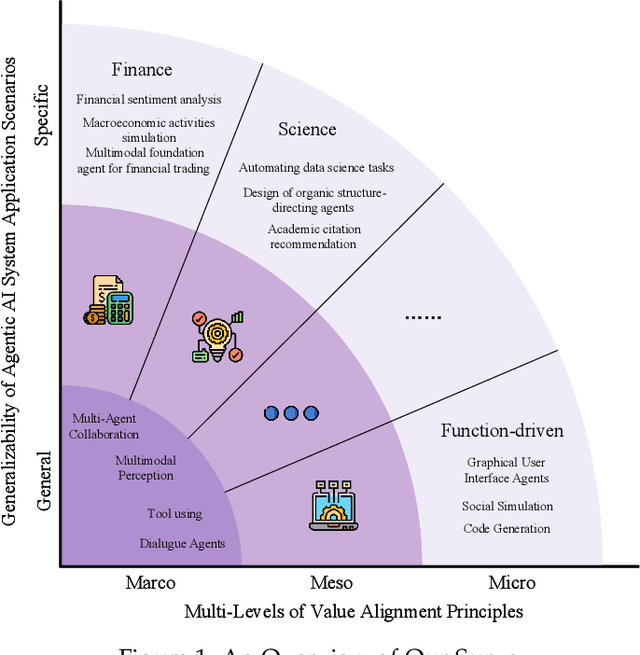
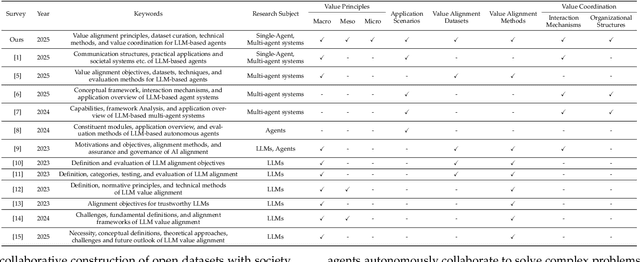
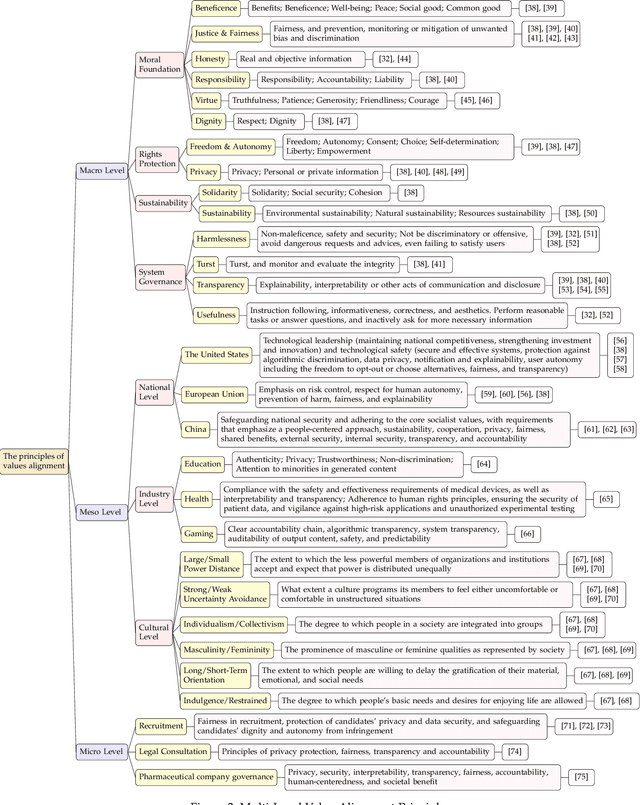
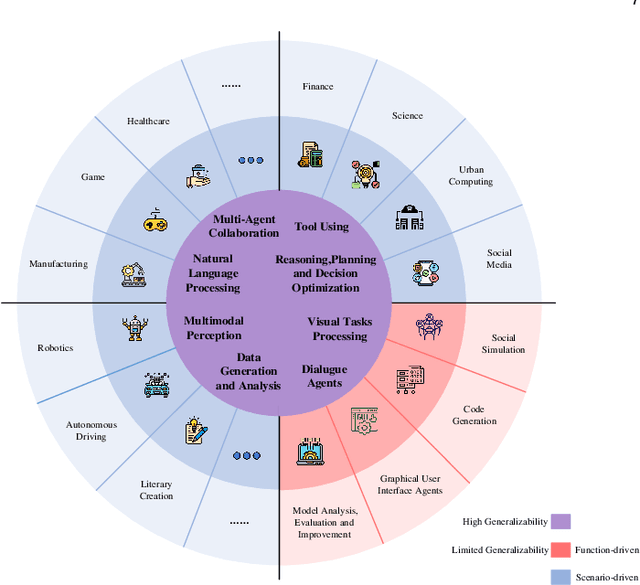
The ongoing evolution of AI paradigms has propelled AI research into the Agentic AI stage. Consequently, the focus of research has shifted from single agents and simple applications towards multi-agent autonomous decision-making and task collaboration in complex environments. As Large Language Models (LLMs) advance, their applications become more diverse and complex, leading to increasingly situational and systemic risks. This has brought significant attention to value alignment for AI agents, which aims to ensure that an agent's goals, preferences, and behaviors align with human values and societal norms. This paper reviews value alignment in agent systems within specific application scenarios. It integrates the advancements in AI driven by large models with the demands of social governance. Our review covers value principles, agent system application scenarios, and agent value alignment evaluation. Specifically, value principles are organized hierarchically from a top-down perspective, encompassing macro, meso, and micro levels. Agent system application scenarios are categorized and reviewed from a general-to-specific viewpoint. Agent value alignment evaluation systematically examines datasets for value alignment assessment and relevant value alignment methods. Additionally, we delve into value coordination among multiple agents within agent systems. Finally, we propose several potential research directions in this field.
ART: Anonymous Region Transformer for Variable Multi-Layer Transparent Image Generation
Feb 25, 2025Multi-layer image generation is a fundamental task that enables users to isolate, select, and edit specific image layers, thereby revolutionizing interactions with generative models. In this paper, we introduce the Anonymous Region Transformer (ART), which facilitates the direct generation of variable multi-layer transparent images based on a global text prompt and an anonymous region layout. Inspired by Schema theory suggests that knowledge is organized in frameworks (schemas) that enable people to interpret and learn from new information by linking it to prior knowledge.}, this anonymous region layout allows the generative model to autonomously determine which set of visual tokens should align with which text tokens, which is in contrast to the previously dominant semantic layout for the image generation task. In addition, the layer-wise region crop mechanism, which only selects the visual tokens belonging to each anonymous region, significantly reduces attention computation costs and enables the efficient generation of images with numerous distinct layers (e.g., 50+). When compared to the full attention approach, our method is over 12 times faster and exhibits fewer layer conflicts. Furthermore, we propose a high-quality multi-layer transparent image autoencoder that supports the direct encoding and decoding of the transparency of variable multi-layer images in a joint manner. By enabling precise control and scalable layer generation, ART establishes a new paradigm for interactive content creation.
Research on the Laws of Multimodal Perception and Cognition from a Cross-cultural Perspective -- Taking Overseas Chinese Gardens as an Example
Dec 29, 2023This study aims to explore the complex relationship between perceptual and cognitive interactions in multimodal data analysis,with a specific emphasis on spatial experience design in overseas Chinese gardens. It is found that evaluation content and images on social media can reflect individuals' concerns and sentiment responses, providing a rich data base for cognitive research that contains both sentimental and image-based cognitive information. Leveraging deep learning techniques, we analyze textual and visual data from social media, thereby unveiling the relationship between people's perceptions and sentiment cognition within the context of overseas Chinese gardens. In addition, our study introduces a multi-agent system (MAS)alongside AI agents. Each agent explores the laws of aesthetic cognition through chat scene simulation combined with web search. This study goes beyond the traditional approach of translating perceptions into sentiment scores, allowing for an extension of the research methodology in terms of directly analyzing texts and digging deeper into opinion data. This study provides new perspectives for understanding aesthetic experience and its impact on architecture and landscape design across diverse cultural contexts, which is an essential contribution to the field of cultural communication and aesthetic understanding.